
If you are eating clean, training hard, and still feel like your recovery, sleep, and body composition are working against you, CJC-1295 and Ipamorelin peptide therapy may be worth a conversation. At Peak Performance Wellness & Aesthetics in Johnson City, Eddie Hughes, FNP-BC builds each peptide protocol around your labs and your goals, not a one-size-fits-all template.
This growth hormone peptide combination is one of the most requested performance and recovery therapies in the Tri-Cities. Below you will find a straight answer on what it is, who tends to be a good candidate, what the day-to-day can actually feel like, and the current regulatory picture you should understand before you start.
Ready to see if you are a candidate?
Book a consultation and lab review with Eddie Hughes, FNP-BC. We serve Johnson City, Kingsport, Bristol, Elizabethton, Gray, and Erwin.
What you’ll learn in this guide
A quick map so you can jump to what matters most to you.
What are CJC-1295 and Ipamorelin?
CJC-1295 and Ipamorelin are two peptides that are used together because they signal the body along complementary paths. CJC-1295 is a growth hormone releasing hormone (GHRH) analog, meaning it encourages the pituitary gland to sustain the release of your own growth hormone. In studies of healthy adults, CJC-1295 has been shown to activate the growth hormone and IGF-1 axis (Teichman et al., 2006). Ipamorelin is a growth hormone secretagogue that works more like the hormone ghrelin, prompting a selective pulse of growth hormone. It was described in the research literature as the first secretagogue of its kind that does not meaningfully raise cortisol or prolactin, even at doses far above what is needed to release growth hormone (Raun et al., 1998).
Used as a pair, they support the body’s own growth hormone rhythm rather than replacing it. Growth hormone naturally declines with age, and that shift can quietly show up as slower recovery, lighter sleep, softer body composition, and lower daytime energy. The goal of therapy is to support your natural signaling under medical supervision, then measure the response with lab work.
It is worth being honest about the evidence. The individual peptides have human research behind them, but high-quality studies of the specific CJC-1295 plus Ipamorelin combination are limited, and much of what exists comes from small or animal studies (Injectable Peptide Therapy review, 2026). That is exactly why we treat this as a supervised, individualized therapy with lab monitoring rather than a guaranteed outcome.
Why growth hormone matters
Growth hormone is made naturally by your pituitary gland, and it has a hand in a lot of the things people come to us hoping to improve: muscle repair and recovery after exercise, how your body builds and preserves lean tissue, collagen production for skin and connective tissue, metabolism and how you use fat for energy, sleep quality, bone health, and healthy aging.
Growth hormone output declines gradually as you get older. That slow drop is one reason many adults start to notice slower recovery, less lean muscle, lower energy, and changes in how their body is built, even when their habits have not changed. CJC-1295 and Ipamorelin are used to support your own growth hormone and IGF-1 signaling rather than replace it.
Does this sound like where you are right now?
Most people who ask us about CJC-1295 and Ipamorelin are not looking for a shortcut. They are usually doing the work already and still feeling stuck. It often looks like this.
Where a lot of patients start
- Workouts that used to feel productive now leave you sore for days
- Sleep feels shallow, and you wake up less recovered than you went to bed
- Body composition is drifting even though your habits have not changed much
- Energy dips hard in the afternoon
- Minor injuries and nagging joints seem to linger longer than they should
What patients tend to be chasing
- Deeper, more restorative sleep that carries into the next day
- Faster bounce-back between hard training sessions
- A leaner physique to show for their nutrition and training
- Steadier energy without the mid-afternoon crash
- A recovery capacity that feels closer to a younger version of themselves
Peptide therapy is not magic, and results vary from person to person. What we can tell you is that the patients who do best treat it as one supported piece of a bigger plan that already includes sleep, protein, resistance training, and honest lab data.
Potential benefits patients ask about
Research and clinical experience point to several areas where the growth hormone system plays a role. The items below reflect a mix of what the research suggests and what patients commonly describe in clinical practice. They are potential benefits that depend on candidacy, dosing, and consistency, not guarantees, and for the specific peptide combination the human evidence is still limited.
Recovery and repair
Growth hormone signaling supports tissue repair, which is why recovery is often the first thing performance-minded patients are hoping to improve.
Lean muscle support
By supporting the body’s own growth hormone activity, this combination is often used alongside resistance training to help preserve and build lean tissue.
Body composition and fat
Growth hormone influences how the body uses fat for energy, which is why fat loss and belly fat come up so often. It works best paired with nutrition and activity, not on its own.
Sleep quality
Your largest natural growth hormone pulse happens during deep sleep. Improved sleep is one of the changes patients most commonly describe to us, though individual response varies.
Energy and vitality
Better recovery and deeper sleep tend to show up as steadier daytime energy over the following weeks.
Skin and connective tissue
Growth hormone plays a role in collagen production, so some patients pursue it as part of a broader longevity and skin-quality goal.
What life on therapy can look like, and when
Timelines are individual, but here is a realistic sense of how the experience tends to unfold for candidates who follow their protocol consistently.
The first few weeks
In our experience, the change patients describe first is usually sleep. Deeper, more consolidated sleep often shows up before anything visible in the mirror does. This is a common pattern, not a promise.
Around one to two months
This is where recovery and energy tend to become more obvious. Training sessions feel less punishing afterward, and the afternoon crash softens.
Around three months and beyond
Body composition and lean muscle changes are slower to appear and depend heavily on your training and nutrition. This is also when we re-check labs to see how your body is actually responding and adjust the plan.
Because responses vary, we do not ask you to guess. We measure. That is the difference between chasing a trend and running a supervised protocol.
What CJC-1295 and Ipamorelin cannot do
Setting honest expectations means being clear about the limits too:
- They will not replace good nutrition or consistent training. They support your effort, they do not stand in for it.
- They do not work overnight. Meaningful changes build over weeks and months.
- They will not permanently stop aging or freeze your body in place.
- They will not produce identical results in everyone. Your age, health, habits, and biology all shape the response.
If a provider or a website promises guaranteed, dramatic results, treat that as a reason to be skeptical, not reassured.
Are you a good candidate?
CJC-1295 and Ipamorelin are not right for everyone, and part of Eddie’s job is to tell you honestly when they are not. Candidacy is determined during your consultation and lab review.
Often worth exploring for
- Adults noticing age-related decline in recovery, sleep, or energy
- Active people who want a clinician-guided plan instead of self-directed use
- Patients who want their protocol built on labs, not guesswork
- People already dialing in nutrition, training, and sleep who want added support
Who should avoid CJC-1295 and Ipamorelin?
These peptides are not right for everyone. You should not use them, or should proceed only after careful medical evaluation, if any of the following apply:
- Active cancer or a history of certain cancers, since growth hormone and IGF-1 can influence cell growth
- Pregnancy or breastfeeding
- Uncontrolled diabetes or significant blood sugar problems
- Certain endocrine or pituitary disorders
- A known allergy to the peptide or its components
- Any other part of your history that warrants caution
Part of Eddie’s job is to screen for these honestly and tell you plainly when this is not the right path, rather than starting a therapy that does not fit your situation.
Is CJC-1295 and Ipamorelin right for you?
Three quick questions. This is a starting point, not a diagnosis. Your consultation and labs make the real call.
What are you most hoping to improve?
Do any of these currently apply to you? Active or past cancer, pregnancy or breastfeeding, or uncontrolled diabetes.
Which sounds more like what you want?
Not sure if this is a fit?
Book a free consultationRisks and what to watch for
Because these peptides act on the growth hormone axis, the things to watch for tend to track with growth hormone activity. Most reported effects are mild, but you should understand them before you start, and they are part of why ongoing monitoring matters.
- Fluid retention and swelling. Mild water retention or puffiness, especially early on, is one of the more common effects and often settles as your dose is adjusted.
- Numbness or tingling. Some people notice carpal tunnel type symptoms in the hands, which are linked to fluid shifts and usually respond to a dose change.
- Blood sugar and insulin sensitivity. Growth hormone can influence how your body handles glucose, so if you have prediabetes, diabetes, or insulin resistance, this is an important part of your evaluation and monitoring.
- Injection site reactions. Temporary redness, itching, or irritation where you inject is common and usually minor.
- Headache or lightheadedness. These are reported by some patients and are typically short-lived.
- Long-term uncertainty. Long-term safety data for these peptides is limited, which is a genuine reason we keep protocols supervised, run them in monitored blocks, and re-check your labs rather than leaving you on an open-ended plan.
This is not a complete list, and your own risk picture depends on your history and current medications. That conversation is part of your consultation, and it is why we screen candidacy carefully rather than treating this as a therapy for everyone.
How peptide therapy works at Peak Performance
We treat peptides as medicine, which means a real workup, real oversight, and a plan that is reviewed over time.
- Consultation. You sit down with Eddie Hughes, FNP-BC for a comprehensive health history, a medication and symptom review, and an honest conversation about your lifestyle, your goals, and whether this path makes sense for you. If it does, we cover informed consent so you understand the therapy before you commit.
- Baseline labs. We order lab work, including markers such as IGF-1, so your plan is built on data rather than assumptions.
- Your personalized protocol. If you are a candidate, we design a dosing plan tailored to you, using peptides that are medically sourced and independently analyzed for purity, and walk you through injection technique so you are confident using it.
- Monitoring and follow-up. We re-check how your body is responding, review repeat labs, and refine the protocol for safety and results rather than setting it and forgetting it.
Want to track the changes objectively? Ask about pairing therapy with a body composition scan so you can see progress in numbers, not just feel it.
How are CJC-1295 and Ipamorelin administered?
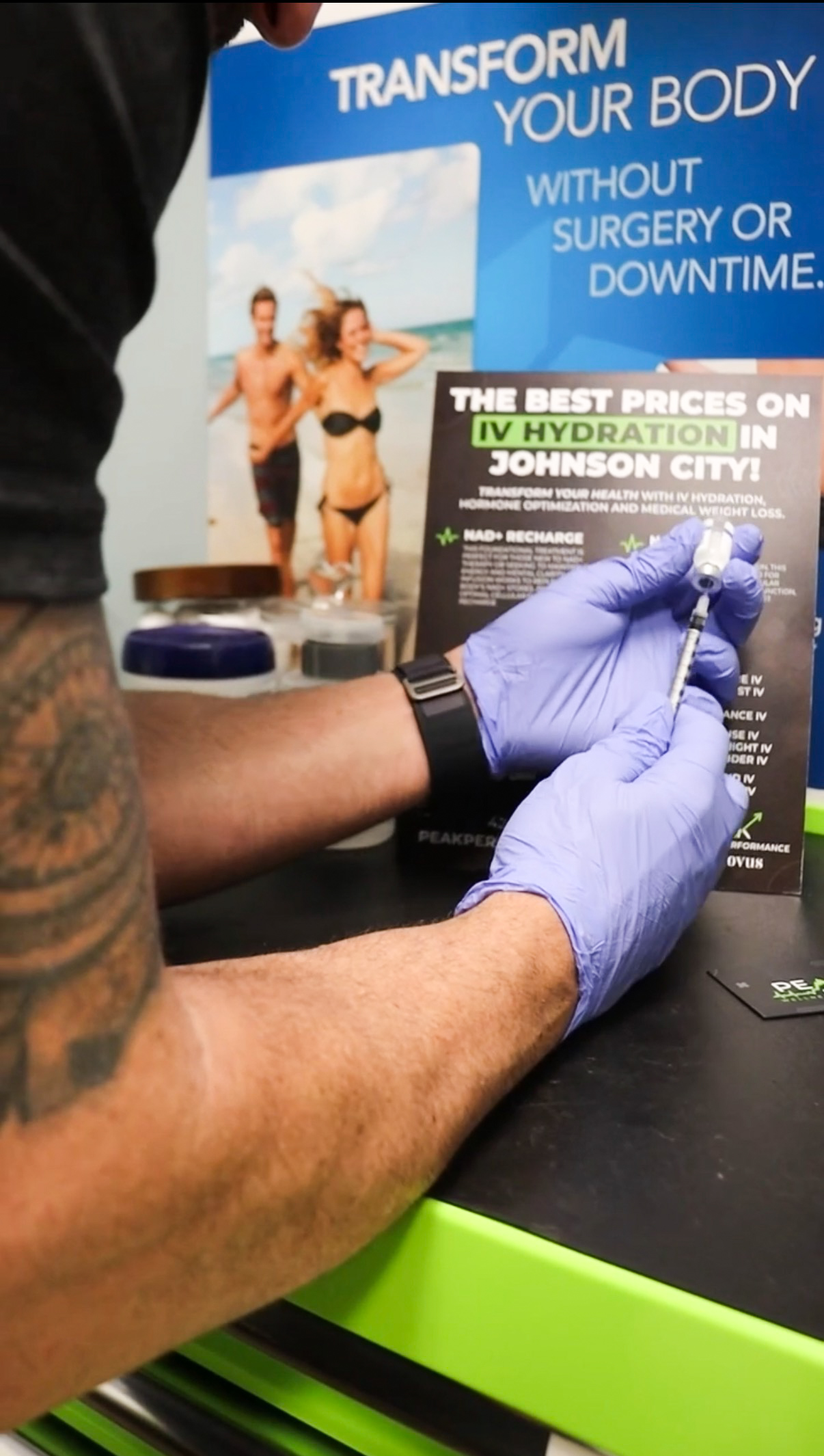
This is one of the most common questions, and the honest answer is that it is simpler than most people expect. CJC-1295 and Ipamorelin are usually given as a small subcutaneous injection, meaning just under the skin, using a very fine insulin-style needle. Most people inject into the abdomen or thigh. The needle is tiny, the injection is quick, and our team teaches you the technique in the clinic so you are comfortable before you ever do it on your own. Patients who felt nervous about self-injection at first almost always tell us it turned out to be a non-issue.
Not FDA-approved: what you should know
Being clear about this matters. CJC-1295 and Ipamorelin are not FDA-approved medications, and neither has completed the full FDA approval process for a specific therapeutic indication. At Peak Performance they are not sold over the counter and are not something you self-source. They are medically sourced through a specialized medical supply company, with laboratory analysis for identity, purity, and consistency, and they are recommended and dosed by your provider only after an appropriate evaluation.
The regulatory status of these peptides has been actively changing. In late 2023 the FDA placed a group of peptides, including CJC-1295 and Ipamorelin, into a restricted category, and that classification has been in transition through 2025 and 2026 as the agency reconsiders how these substances are handled. Because availability can shift with these decisions, the honest answer to “can I start today” is that it depends on current availability at the time of your visit, which we will confirm with you directly. You can read the FDA’s overview of these substances and how they are currently regulated on its bulk drug substances page.
Why medical supervision matters
You can find peptides for sale online labeled “for research use only.” Those are not intended for human use, their quality is not verified, and using them without medical guidance is where people get into trouble. Supervised therapy is different in the ways that count.
- Your peptides are obtained through medical sourcing with laboratory analysis, not bought from an unregulated website.
- Your dose is guided by lab work such as IGF-1 and your clinical response, not a protocol you copied from a forum.
- A licensed provider evaluates, doses, monitors, and adjusts your plan based on how your body actually responds.
- Problems get caught early because someone is genuinely watching.
The peptides are the same molecules either way. The safety comes from the supervision around them.
How it compares: TRT, GLP-1 medications, and other peptides
Three questions come up constantly, so here are direct answers.
Will CJC-1295 and Ipamorelin raise my testosterone?
Not directly. These peptides act on the growth hormone pathway, which is separate from the testosterone pathway. If low testosterone is your actual concern, the right conversation is about low testosterone therapy or broader hormone optimization. Some patients pursue growth hormone peptides alongside testosterone therapy under supervision, and your consultation is where we sort out which levers actually apply to you.
Is this like Ozempic or a peptide for fat loss?
Not really. Medications like semaglutide and tirzepatide are GLP-1 based and work through a different mechanism aimed squarely at weight loss and appetite. If dedicated weight loss is your goal, our medical weight loss program and GLP-1 medications are the more direct tools. CJC-1295 and Ipamorelin support a leaner build through growth hormone signaling, which is a complement to, not a replacement for, a focused weight loss plan.
How does it fit with other peptides you offer?
Recovery-focused patients often ask about pairing goals across our peptide menu, including BPC-157 and the Wolverine Stack. Any combination is a clinical decision made with Eddie based on your labs and goals, never a stack you assemble on your own.
Why patients choose Peak Performance
We do not believe in selling peptides to everyone who walks through the door. We believe you deserve an honest recommendation based on your symptoms, your lab work, your medical history, and realistic goals. Sometimes that means telling you this is not the right fit, and we are genuinely fine with that.
- A board-certified provider, Eddie Hughes, FNP-BC, who personally oversees your care
- Individualized, lab-guided dosing rather than a one-size-fits-all protocol
- Peptides obtained through medical sourcing with laboratory analysis for purity and consistency
- Ongoing medical supervision and monitoring
- A focus on education instead of a sales pitch
Peptide therapy also connects to the rest of what we do across the Tri-Cities, from men’s health and hormone optimization to regenerative medicine, so your plan can fit the bigger picture of your health rather than sit off to the side.
Serving the Tri-Cities
Peak Performance Wellness & Aesthetics sits right on Bristol Highway in Johnson City, an easy drive from across the region.
What our patients say
Frequently asked questions
What are the benefits of CJC-1295 and Ipamorelin?
Patients most commonly pursue this combination for recovery, sleep quality, lean muscle support, body composition, and steadier energy. It works by supporting your body’s own growth hormone signaling rather than replacing the hormone. Benefits depend on candidacy, dosing, and consistency, and they are evaluated with lab work over time.
How long should you take CJC-1295 and Ipamorelin?
There is no single answer that fits everyone. Protocols are typically run in supervised blocks with lab checks along the way, and your provider decides duration based on your response and goals. Many programs are structured in cycles rather than open-ended use, which we discuss during your consultation.
What are the downsides or side effects of Ipamorelin?
Reported side effects are usually mild and can include temporary redness or irritation at the injection site, water retention, headache, or lightheadedness. Ipamorelin is considered a relatively selective secretagogue, which is part of why it is often chosen. Any therapy carries considerations, which is why medical oversight and lab monitoring matter. Tell your provider about your full history so risks can be evaluated for you specifically.
Does CJC-1295 target belly fat?
Growth hormone influences how the body mobilizes fat for energy, and visceral fat around the midsection is one area patients ask about. That said, no peptide spot-reduces fat on its own. The patients who see body composition changes pair therapy with nutrition, resistance training, and consistency. A body composition scan is a good way to track it objectively.
Can CJC-1295 and Ipamorelin increase testosterone?
Not directly. These peptides act on the growth hormone axis, which is separate from testosterone. If low testosterone is your concern, testosterone therapy or hormone optimization is the more relevant path, and we can evaluate both during your visit.
How fast does it work?
Timelines vary. Many patients notice improved sleep within the first few weeks, with recovery and energy becoming more apparent over one to two months. Body composition changes are slower and typically assessed around the three-month mark alongside repeat labs.
How much should I take for fat loss?
Dosing is individualized and determined by your provider after reviewing your labs and goals. We do not recommend self-directed dosing from online sources, both for safety and because unregulated research-grade peptides are not intended for human use. Your protocol is medically sourced and dosed with instructions specific to you.
Do I need to cycle off?
Many protocols are structured in cycles rather than continuous use, and whether and how you cycle is a clinical decision made with your provider based on your response and goals. This is one of the things we map out together so you are never guessing.
Are peptides safer than TRT?
They are different tools that address different things, so it is not a simple safer-or-not comparison. Growth hormone peptides support one pathway, testosterone therapy supports another, and the right choice depends on your labs, symptoms, and goals. Both require proper evaluation and monitoring. The safest option for anyone is the one chosen and supervised by a qualified provider.
Are these FDA-approved?
No. CJC-1295 and Ipamorelin are not FDA-approved brand-name drugs. Their regulatory status has been changing through 2025 and 2026 as the FDA reviews how these substances are handled, so current availability is confirmed at the time of your visit. At Peak Performance they are medically sourced, analyzed for purity, and dosed by your provider after an evaluation.
Are CJC-1295 and Ipamorelin legal?
Used under the direction of a licensed medical provider after an evaluation, they are handled very differently from something bought off an unregulated website. They are not FDA-approved brand drugs, and their regulatory status has been in transition, which we confirm at your visit. Sourcing “research only” peptides online for personal use is a different and riskier situation.
Are peptides the same as steroids?
No. Anabolic steroids are synthetic hormones you add directly to the body. These peptides are signaling molecules that encourage your own pituitary gland to release your own growth hormone. Different mechanism, different risk profile.
Do CJC-1295 and Ipamorelin increase HGH?
They are designed to prompt your body to release more of its own growth hormone in a natural, pulsing pattern, rather than injecting growth hormone directly. That is a key distinction from taking synthetic HGH.
Can women take CJC-1295 and Ipamorelin?
Yes. Candidacy is individual and based on your labs, history, and goals rather than gender. Women who are pregnant or breastfeeding should not use them.
Can I exercise and drink alcohol while on peptide therapy?
Exercise is encouraged and tends to complement therapy. Heavy alcohol use works against your recovery, sleep, and results, so moderation matters. Your provider can give guidance specific to your situation.
What happens if I miss a dose?
An occasional missed dose is generally not an emergency. Follow the instructions you are given, do not double up to make up for it, and reach out if you are unsure. Consistency over time is what drives results.
Are these peptides safe?
Safety depends heavily on sourcing and oversight. When they are medically sourced with laboratory analysis for purity and used under the evaluation and monitoring of a licensed provider, they are held to a very different standard than unregulated online “research” peptides. That difference is the one that matters most.
Let’s find out if this is right for you
A consultation and lab review with Eddie Hughes, FNP-BC is the honest first step. No pressure, no guesswork, just a clear read on whether CJC-1295 and Ipamorelin fit your goals.
Visit Peak Performance Wellness & Aesthetics
(423) 212-3703
Mon, Tue, Wed 9AM to 5PM | Thu 9AM to 6PM | Fri 9AM to 2:30PM | Sat & Sun Closed
Medical references
- Teichman SL, et al. Activation of the GH/IGF-1 axis by CJC-1295 in normal adult subjects. National Library of Medicine (PubMed). pubmed.ncbi.nlm.nih.gov/19386527
- Raun K, et al. Ipamorelin, the first selective growth hormone secretagogue. National Library of Medicine (PubMed). pubmed.ncbi.nlm.nih.gov/9849822
- Injectable Peptide Therapy: A Primer for Orthopaedic and Sports Medicine Physicians. National Library of Medicine (PubMed). pubmed.ncbi.nlm.nih.gov/41476424
- U.S. Food and Drug Administration. Certain Bulk Drug Substances for Use in Compounding That May Present Significant Safety Risks. fda.gov
About the medical reviewer
Eddie Hughes, FNP-BC is a board-certified family nurse practitioner and the provider behind Peak Performance Wellness & Aesthetics in Johnson City. His clinical background spans more than 15 years across emergency medicine, neurosurgery, hospital medicine, and regenerative medicine, and he personally leads the clinic’s peptide, hormone, and metabolic care. Every peptide protocol at Peak Performance is recommended, dosed, and monitored under his direct supervision.
Medical disclaimer: This page is for educational purposes only and is not a substitute for professional medical advice, diagnosis, or treatment. CJC-1295 and Ipamorelin are not FDA-approved medications, and are only appropriate for select patients following evaluation. Individual results vary. Any peptide therapy should be undertaken only under the guidance of a qualified healthcare provider. Always discuss your full medical history and current medications with your provider before starting a new therapy.
Curious if peptide therapy fits your goals?
Book free consult