

Medically reviewed by Eddie Hughes, FNP-BC
Family Nurse Practitioner, Board Certified. Over 15 years across emergency medicine, neurosurgery, and regenerative medicine. Peak Performance Wellness & Aesthetics, Johnson City, TN
Why weight gain happens during menopause and perimenopause, and what can help
Weight and body composition changes in midlife are influenced by both aging and the menopause transition. As estrogen declines, fat storage tends to shift toward the abdomen while lean muscle declines and insulin sensitivity falls. The result is that the same eating and exercise habits that held your weight steady at 40 often stop working at 50. This is a measurable physiological change, not a discipline problem.
Treatment works best when it addresses the hormonal, metabolic, and weight-related factors together rather than one at a time. At Peak Performance Wellness & Aesthetics in Johnson City, that means lab testing to screen for what may be contributing, menopausal hormone therapy where it is appropriate, weight loss medication when it is indicated, and body composition tracking so you can see whether you are losing fat or losing muscle. Call (423) 212-3703 to schedule a consultation.
Quick answers
- Average gain
- Women gain an average of about 1.5 pounds per year in midlife, with fat gain accelerating and lean mass declining around the final menstrual period.
- Where it goes
- The abdomen. As estrogen declines, fat storage tends to shift from a lower-body pattern to a midsection pattern, including visceral fat around the organs. This is what many women call menopause belly or meno belly.
- Why your old routine may not work the same
- Lean muscle declines during the transition. Less muscle means a lower resting metabolic rate, so your body needs fewer calories than it used to.
- Does hormone therapy cause weight loss?
- No. Menopausal hormone therapy is not a weight loss medication and should not be marketed as one. Research suggests it may help attenuate the increase in central abdominal fat and support more favorable body composition in appropriately selected women, which is a different benefit.
- Do GLP-1 medications still work after menopause?
- Yes. In a post hoc analysis of 2,542 women from the SURMOUNT trials, tirzepatide produced similar body weight reduction in postmenopausal women as in premenopausal women.
- Does it keep accelerating forever?
- Usually not. The menopause-related acceleration in body composition change tends to slow after the transition. But weight or abdominal fat already gained tends to persist unless something changes.
What is happening to your body
Three changes often overlap during perimenopause and menopause, and they can compound each other.
Change one
Fat relocates to your middle
Estrogen influences where your body stores fat. As it declines, storage shifts away from the hips and thighs toward the abdomen, including visceral fat around the organs. Research on the menopause transition shows the hormonal shift is clearly associated with an increase in total body fat and a specific increase in abdominal fat.
This is why your clothes tell you before the scale does. Women describe their weight as having moved rather than increased.
Change two
Muscle leaves quietly
Muscle is metabolically expensive tissue, so as it drops your resting metabolic rate drops with it. Muscle mass naturally declines with age, and the menopause transition can accelerate changes in lean mass.
Nothing about this announces itself. It shows up months later as the same meals landing differently than they used to.
Change three
Food gets handled differently
Lower estrogen is associated with reduced insulin sensitivity and reduced fat oxidation. Changes in how your body handles blood sugar can make weight management harder, and are associated with greater cardiometabolic risk in midlife.
Many women also notice cravings get harder to ride out, which is easy to read as a willpower problem when it is not one.
Not sure which of these is driving yours? That is exactly what lab work answers.
Sleep loss and night sweats make all three worse. If you are waking up multiple times a night, appetite regulation is affected the next day. This is one reason treating hot flashes and night sweats often has a downstream effect on weight.
Perimenopause weight gain versus menopause weight gain
Most women start noticing the change well before their periods stop. Hormones do not switch off on a birthday. They shift gradually, and the stage you are in changes what is worth doing about it.
Stage 01
Before the transition
Typically 20s to late 30s
Hormone patterns are relatively stable and cycles are usually predictable.
- Weight tends to respond to changes in eating and activity
- Muscle is easier to maintain
- Recovery is generally quicker
Stage 02
Perimenopause
Often begins mid-40s, sometimes earlier
Hormones fluctuate rather than simply declining. Periods are still happening, so many women do not connect the two.
- Weight gain is often gradual and confusing
- Sleep and mood changes are common
- Body composition gets harder to hold
Stage 03
Menopause
Average age 51 in the United States
Diagnosed after twelve consecutive months without a period. It is a single point in time, not a phase.
- Estrogen settles at a new baseline
- Fat storage shifts toward the midsection
- Hot flashes and night sweats often peak
Stage 04
Postmenopause
Everything after that point
Fat gain tends to accelerate in the first couple of years, then the rate of change flattens out.
- Lean mass loss becomes more pronounced
- Bone and muscle health matter more
- Cardiometabolic risk factors can change
One thing worth saying plainly for women still in perimenopause: pregnancy is still possible until menopause is established. Weight loss medication is not used for weight reduction during pregnancy, so pregnancy plans and contraception are part of the discussion before treatment begins. Tirzepatide can also reduce the effectiveness of oral hormonal contraceptives when you start it and after each dose increase, which may mean temporary backup contraception or switching to a nonoral method. If you are still cycling and on the pill, raise it at your consultation.
Postmenopause is often the window where the weight becomes hardest to move.
You do not need to be fully postmenopausal to be evaluated or treated. Many women seek help during perimenopause, before their periods have stopped.
Wherever you land on that timeline, the first step is the same: testing instead of guessing.
What used to work is not going to work
You already know the advice. Eat less, move more, be more disciplined. Most women have tried harder at it in the last two years than they did through their entire thirties, and the scale has not budged.
Trying harder has a cost, though. Cutting calories further without enough protein and without resistance training comes out of muscle. The weight goes down, you feel worse, your body looks softer than before you started, and the scale congratulated you at every step.
Cardio has a similar blind spot. It is genuinely good for your heart, your fitness, and your mood. It is not what builds the muscle that protects your metabolic rate, and most routines built before midlife are heavy on cardio and light on lifting.
If eating less and moving more stopped working, you did not fail at it. You were running a strategy built for a body with different hormones.
Does this sound like what you are dealing with?
Six quick questions. Nothing is stored, nothing is sent, and this is not a diagnosis. It is a way to organize what you are noticing so the conversation at your consultation starts further along.
This tool does not diagnose menopause, perimenopause, or any medical condition, and it does not determine whether you are a candidate for any treatment. Candidacy is determined at consultation with a licensed provider after review of your history and lab work.
How we treat menopause weight gain at Peak Performance
Step 01
Screen for what may be contributing
Not all midlife weight gain is menopause. Thyroid dysfunction, prediabetes and diabetes, medication side effects, and sleep apnea can present the same way, and they are treatable on their own terms. We start with lab work before recommending anything.
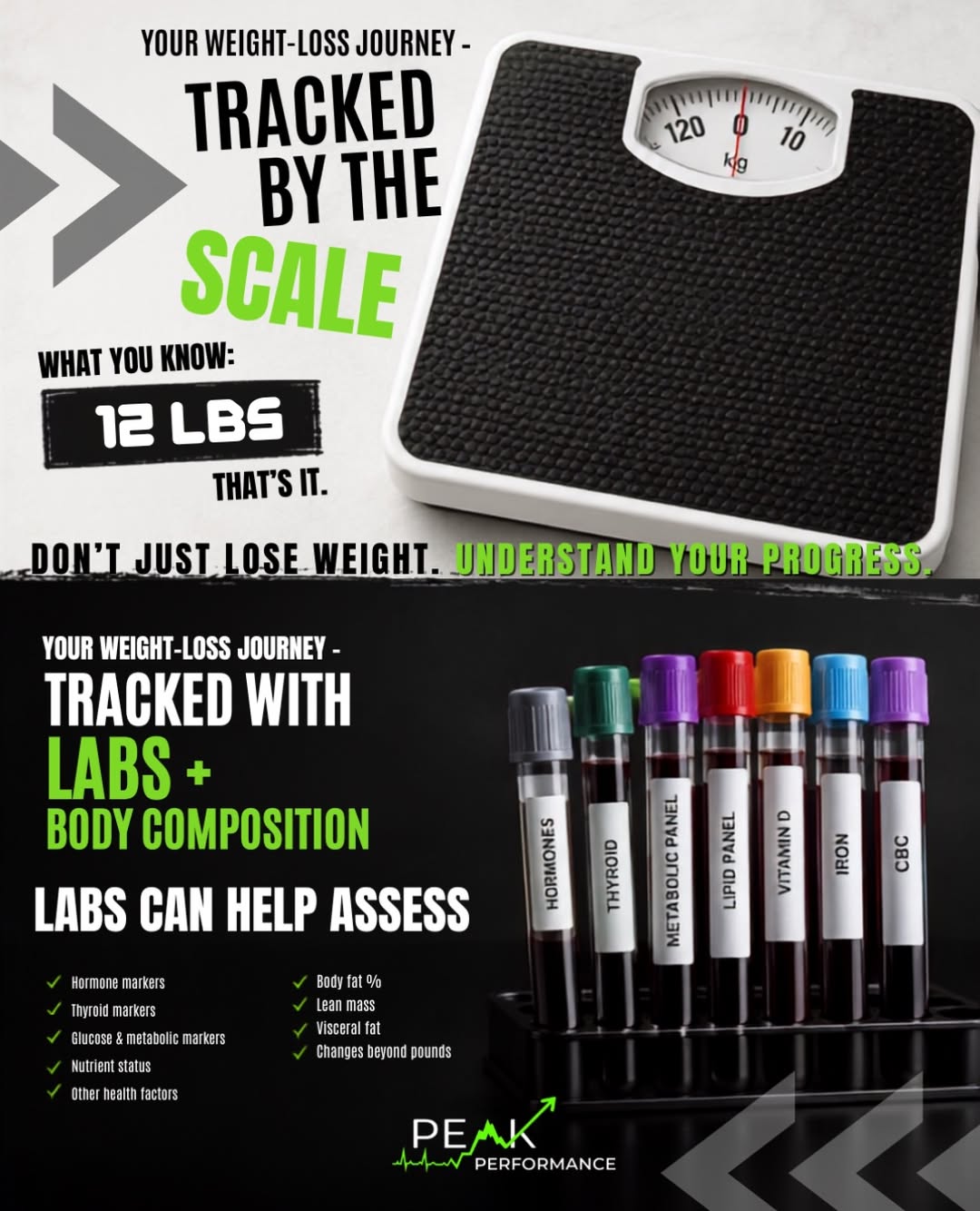
Lab testing is individualized and may include evaluation of thyroid function, blood sugar and metabolic health, cholesterol, and other markers based on your symptoms, medications, and medical history.
Step 02
Measure body composition, not just weight
We use in-office body composition scans to separate fat mass from lean mass. This is especially useful after 45, because the scale can stay flat while fat mass and lean mass move in opposite directions. It also tells us whether a treatment is working. Fifteen pounds down means something very different if twelve of it is fat than if six of it is muscle. The goal is to reduce excess fat while preserving as much lean mass as possible.
Step 03
Hormone therapy where appropriate
Menopausal hormone therapy is not a weight loss drug, and we will not sell it to you as one. What the research suggests is more specific and more useful than that. Hormone therapy may help attenuate the increase in central abdominal fat and may have favorable effects on body composition and insulin sensitivity in appropriately selected women. Many patients also report that better sleep and fewer night sweats make it realistically possible to stick to a plan.
We offer hormone therapy in several delivery forms. You can read more about our approach on our bioidentical hormone replacement therapy page and our hormone pellet therapy for women page. Formulation and route are not interchangeable, and they carry different evidence and approval status, so the right option is decided with your provider rather than chosen from a menu.
Hormone therapy is not appropriate for everyone. Certain cancer histories, unexplained vaginal bleeding, blood clotting or cardiovascular conditions, liver disease, and other medical factors may affect candidacy. We review your full medical history before recommending treatment.
Step 04
GLP-1 weight loss medication when it is indicated
For women who meet criteria for anti-obesity medication, these treatments can produce clinically meaningful weight loss alongside nutrition, activity, and ongoing medical follow-up. Beyond appetite, some patients describe a noticeable reduction in food noise, meaning the constant mental chatter about what and when to eat.
There was real uncertainty about whether these medications worked as well after menopause. The data now suggests they do. A post hoc analysis of 2,542 women across the SURMOUNT-1, SURMOUNT-3, and SURMOUNT-4 trials found that tirzepatide, a dual GIP and GLP-1 receptor agonist, produced significant reductions in body weight, waist circumference, and waist-to-height ratio regardless of reproductive stage. In SURMOUNT-1, women in the postmenopausal group lost approximately 23 percent of body weight compared with 3 percent on placebo, closely tracking the 26 percent seen in premenopausal women. Waist circumference reductions were substantial across every group, which matters because waist measurement is the direct marker of the midsection fat that concerns most women here.
Trial results represent optimal conditions and individual results vary. We offer both tirzepatide and semaglutide.
Step 05 · What makes this different
Treat them together, not separately
Because Peak Performance evaluates menopause symptoms and medical weight management in the same clinic, your plan can account for both rather than treating them as unrelated concerns. Early observational evidence suggests the combination may matter for some postmenopausal women. A retrospective cohort study of 120 matched postmenopausal women, published in early 2026, examined patients treated with tirzepatide for twelve months or longer. Women who were also using hormone therapy achieved greater weight loss and better cardiometabolic outcomes than women who were not. Earlier work published in Menopause in 2024 found a similar pattern with semaglutide, where postmenopausal women using hormone therapy lost meaningfully more weight than those who were not.
The authors are careful, and so are we. This is retrospective observational data, not a randomized trial, and causation has not been established. The researchers note that prospective randomized studies are needed to confirm the finding. It is still a practical reason to have one provider looking at your hormones and your weight in the same appointment instead of two providers each seeing half the picture.
The point of all this
What are you actually working toward?
Not a number on a scale. Getting dressed without the waistband reminding you. Making it past 3 p.m. without needing sugar or a third coffee. Sleeping through the night instead of waking at 3 a.m. Walking into a room and not thinking about your body at all.
That is what we build the plan around, and it is why we measure body composition instead of just weight.
Book a consultation Call (423) 212-3703
First visit covers your history, lab work, and a body composition baseline. Self-pay, with pricing given up front. Results vary.
Step 06
Protect muscle and bone
Rapid weight loss on any medication carries a risk of lean mass loss, and that risk is higher in a population already losing muscle to the menopause transition. We build resistance training and adequate protein intake into the plan from day one, and we track it with body composition scans rather than assuming it is going well.
Bone matters here too, and it is the piece most weight loss programs ignore. Significant weight loss can affect bone as well as muscle, and menopause is already a period of increased bone loss. Resistance and weight-bearing exercise, adequate nutrition, calcium and vitamin D where appropriate, and bone density screening based on your individual risk all belong in the conversation.
What life looks like when this is under control
Women often come in focused on a number on the scale. What treatment aims at is broader than that, and patients frequently tell us the scale stops being the thing they measure by.
Clothes that fit
Not necessarily a smaller size, but the specific frustration of a waistband that no longer sits right. Getting dressed stops being a daily reminder.
Steadier energy through the day
Many patients report that the afternoon crash eases before any significant weight has moved.
Better sleep
When menopause symptoms like night sweats are controlled, sleep tends to improve. Patients describe that single change as making everything else easier, including appetite and mood.
Strength you can feel
Women who add resistance training during treatment often report being physically stronger in their fifties than in their forties. Carrying groceries, keeping up on a hike, playing with grandchildren without needing to sit down.
Quieter food noise
The constant low-grade calculation about what to eat, the guilt, the sense that your body has become an opponent. Patients often describe that mental chatter quieting once they have a plan that is actually working with their physiology.
Many women tell us they had quietly accepted that this was simply what getting older felt like, and had stopped expecting to feel good. Finding out it was treatable is the part they wish they had known sooner.
Results vary and no outcome is guaranteed. But the belief that midlife weight gain is something you simply have to accept is not supported by current evidence.
What women in the Tri-Cities say
Johnson City, Tennessee
You do not have to accept this as your new normal
Most women wait years before asking, because someone told them this was just what getting older looks like. It took one appointment to find out otherwise.
Start with answers, not another diet.
Book a consultation Call (423) 212-3703
Johnson City, serving the Tri-Cities. Self-pay with pricing up front. Results vary and candidacy is determined at consultation.
What to expect at your first visit
Consultation and history. We talk through your symptoms, your cycle status, what you have already tried, your medications, and your health history. Bring any recent lab work.
Lab work. Drawn at the visit or scheduled, depending on timing.
Body composition scan. Your baseline. Everything gets measured against this.
Your plan. Once labs return, Eddie Hughes, FNP-BC reviews them with you and recommends a path. That may be hormone therapy, a GLP-1, both, or neither if labs point somewhere else.
Follow-up. We schedule your first follow-up based on what you start, then continue on an ongoing schedule based on your response.
This is a self-pay clinic. We tell you what things cost before you commit to them.
That is the entire first visit. No pressure to start anything that day.
Who this is right for
- Women in perimenopause or menopause who have gained weight without a clear change in habits
- Women who have noticed weight moving to the midsection specifically
- Women whose previous approach to weight stopped producing results after 40
- Women dealing with weight gain alongside hot flashes, poor sleep, brain fog, or mood changes
- Women who want contributing factors screened for rather than just being handed a medication
Candidacy and who this may not be right for
- Anyone seeking weight loss medication without lab work or follow-up
- Anyone looking for a rapid short-term result rather than a durable change in body composition
Hormone therapy candidacy. Hormone therapy is not appropriate for everyone. Certain cancer histories, unexplained vaginal bleeding, blood clotting or cardiovascular conditions, liver disease, and other medical factors may affect candidacy. Decisions after a hormone-sensitive cancer are individualized and are made with your oncology team involved.
Weight loss medication candidacy. Semaglutide and tirzepatide have their own criteria, contraindications, and warnings. Contraindications include a personal or family history of medullary thyroid carcinoma or MEN2, and prior serious hypersensitivity to the medication. A history of pancreatitis and other medical factors require individual review before treatment. Cancer history and current oncology medications are reviewed individually, with your oncology team involved when appropriate. Eligibility here is assessed independently of hormone therapy candidacy.
Serving women across the Tri-Cities
Our medical weight loss clinic in Johnson City sees women from Kingsport, Bristol, Elizabethton, Jonesborough, Gray, Boones Creek, Piney Flats, Erwin, Greeneville, and the surrounding communities. We are located at 3980 Bristol Hwy, Johnson City, TN 37601, just off the main corridor between Johnson City and Bristol. For every town we serve, see medical weight loss across the Tri-Cities.
Frequently asked questions
Understanding what is happening
Why am I gaining weight during menopause when nothing about my diet has changed?
Because the way your body handles that same diet has changed. Both aging and the menopause transition contribute. As estrogen declines, fat storage tends to shift toward the abdomen, lean muscle mass drops, and insulin sensitivity falls. Together these mean your body burns fewer calories at rest and stores more of what you eat around your middle. Your habits did not change. Your physiology did.
How much weight do most women gain during menopause?
Women gain an average of about 1.5 pounds per year during midlife. One longitudinal study found an average gain of roughly 12 pounds within eight years of reaching menopause. Fat gain tends to accelerate around the final period while lean mass declines during the same window. Some women gain considerably more and some gain very little.
Why is it all going to my stomach now?
Estrogen influences where fat is stored. With higher estrogen, storage tends to favor the hips and thighs. As estrogen declines, storage shifts toward the abdomen, including visceral fat around the organs. This is also why waist measurement is a better progress marker during menopause than scale weight alone.
What is menopause belly, and is it different from regular weight gain?
Menopause belly, sometimes called meno belly, is the shift of fat storage toward the abdomen that tends to happen as estrogen declines. It is different from general weight gain in that it can happen even when overall weight stays fairly stable, and it includes visceral fat around the organs rather than just fat under the skin. That distinction matters, because visceral fat carries more cardiometabolic risk. It is also why we measure waist circumference and body composition instead of relying on the scale.
Is menopause weight gain permanent?
The accelerated phase is not. The menopause-related acceleration in fat gain and lean mass loss tends to flatten out roughly a couple of years after the final period. What that does not mean is that the weight already gained goes away on its own. It generally persists unless something changes, and what works now is different from what worked in your thirties.
Treatment options
Does hormone replacement therapy make you lose weight?
No. Menopausal hormone therapy is not a weight loss medication and current clinical guidance says it should not be prescribed or marketed primarily as one. Research does suggest it may help attenuate abdominal fat accumulation and support more favorable body composition in appropriately selected women, and it treats the sleep and vasomotor symptoms that make weight management harder. Those are real benefits, but they are different from weight loss.
Do GLP-1 medications like tirzepatide work as well after menopause?
Yes. A post hoc analysis of 2,542 women from the SURMOUNT trials found tirzepatide produced significant reductions in body weight and waist circumference across premenopausal, perimenopausal, and postmenopausal groups. Postmenopausal women lost roughly 23 percent of body weight compared with 3 percent on placebo, similar to premenopausal results. Individual results vary.
Should I do hormone therapy or weight loss medication first?
That depends on your labs, your symptoms, and your goals, and it is decided at consultation. Some women benefit from starting hormones to get sleep and hot flashes under control before adding anything else. Others need weight addressed more urgently. Emerging research suggests postmenopausal women using hormone therapy may respond better to GLP-1 medication, which is one reason we evaluate both together.
Will I lose muscle on a GLP-1 medication?
Some lean mass loss occurs with any significant weight loss, and it is a real concern during menopause when muscle is already declining. That is why we track body composition rather than scale weight, and why resistance training and protein intake are built into the plan from the start rather than added later.
Will weight loss medication affect my bones?
Significant weight loss from any cause can affect bone as well as muscle, which deserves attention during menopause when bone loss is already a concern. Resistance and weight-bearing exercise, adequate nutrition, calcium and vitamin D where appropriate, and bone density screening based on your individual risk are all part of that conversation. We factor this into the plan rather than treating it as an afterthought.
What happens if I stop the medication?
This is worth planning for at the start, not at the end. Weight regain after stopping is common, which is why long-term maintenance gets discussed before treatment begins rather than after. For some patients continued medication is appropriate. Dose and duration are individualized based on response, tolerability, health history, and goals. Nutrition, resistance training, and protein intake remain important whether medication continues or is eventually stopped.
Practical questions
Can I lose menopause weight without medication?
Some women can. Resistance training, adequate protein, sleep, and managing alcohol intake are genuinely effective, and they are part of every plan we build regardless of whether medication is involved. If you have already been doing those things consistently without result, that is useful information and a reason to test rather than to try harder.
How long before I notice a difference?
Sleep and energy often shift within a few weeks. Measurable body composition change generally takes longer. We reassess at follow-up rather than asking you to guess based on the scale. Results vary.
Do I have to be in menopause, or does perimenopause count?
Perimenopause counts, and it is often when the change is first noticed. You do not need to have stopped having periods to be evaluated or treated.
Does insurance cover this?
Peak Performance is a self-pay clinic. Financing through PatientFi is available. We provide pricing before you commit to any treatment.
Next step
Find out what is actually going on
You have already tried the harder version of this. The next step is not more effort, it is information: what your labs say, what your body composition says, and what the two of them together point to.
One visit gets you all three.
Book a consultation Call (423) 212-3703Serving Johnson City, Kingsport, Bristol, Elizabethton, and the wider Tri-Cities. Results vary and candidacy is determined at consultation.
Peak Performance Wellness & Aesthetics
3980 Bristol Hwy, Johnson City, TN 37601
Phone: (423) 212-3703
Mon, Tue, Wed 9AM to 5PM | Thu 9AM to 6PM | Fri 9AM to 2:30PM | Sat and Sun closed
